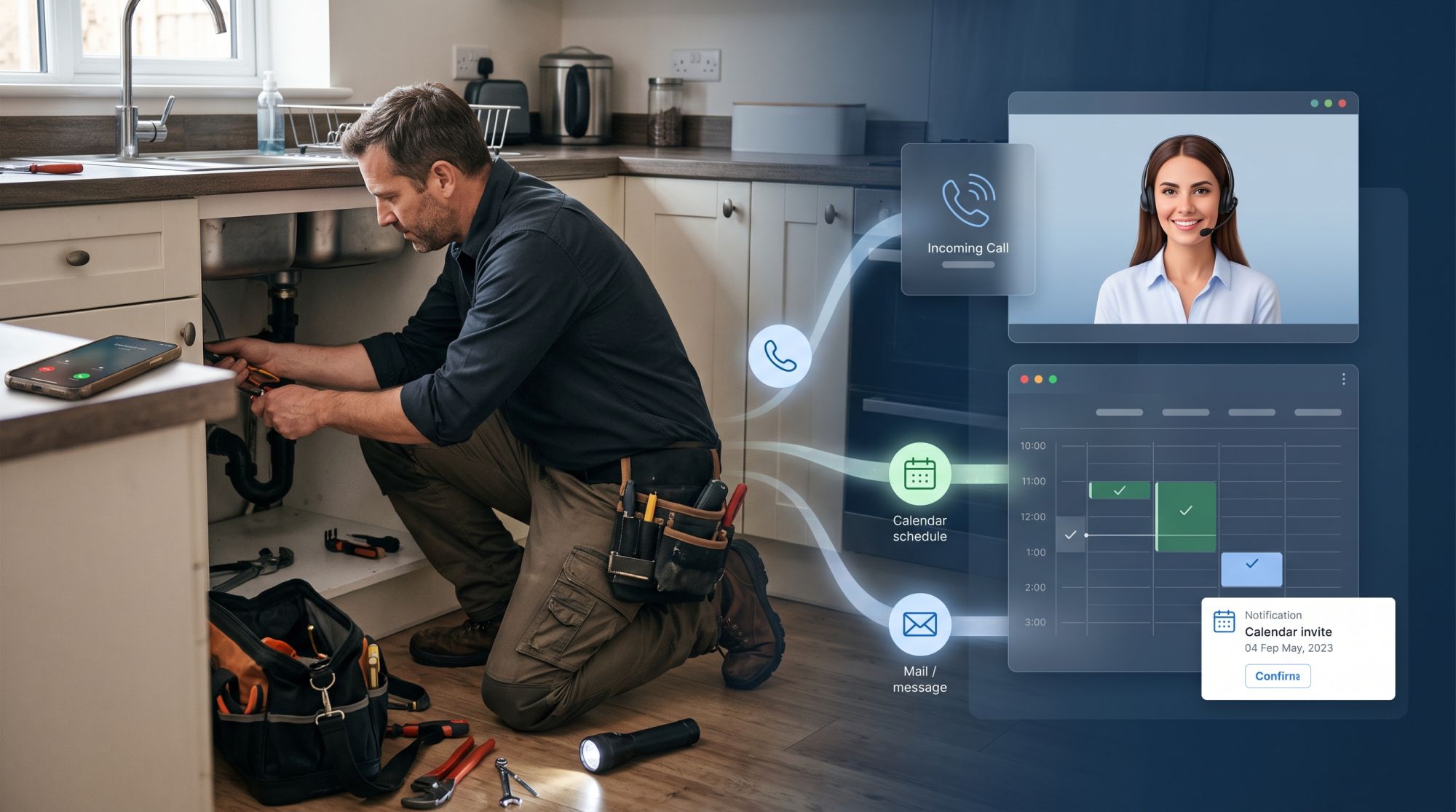
A missed call doesn’t show up anywhere. There is no invoice, no complaint and no line in the accounts. The caller simply rings someone else. That makes it easy to underestimate what unanswered calls cost.
Here is how to work out your own number, why service companies feel it most, and what you can do about it.
What a missed call really costs
A missed call costs you the job the caller wanted to give you, plus everything that customer would have brought later.
The job itself: the work or the booking the caller wanted.
The customer’s future: repeat visits, referrals and reviews that never happen.
The callback time: chasing voicemails, and calling back people who have already found someone else.
The interruptions: staff stopping their work to answer, and the mistakes that come with it.
Work out your own number
Multiply your missed calls by the share that were new enquiries, by how many enquiries you win, and by the value of an average job.
Missed calls a week. Check your phone’s call log, or your provider’s call statistics.
The share that were new enquiries. Not every call is a new customer, so estimate the share that were.
Your hit rate. Of the enquiries you do answer, how many become customers?
The value of an average job.
An example with made-up numbers: 15 missed calls a week × 40% new enquiries × 50% hit rate × €300 per job = €900 a week. Over 50 working weeks, that is €45,000 a year.
Even at half that, €450 a week, it comes to over €20,000 a year, before counting the repeat business those customers would have brought.
Why service companies lose the most
Service companies feel missed calls most, because the phone is where their customers decide.
The need is urgent. A leak, a toothache, a viewing tomorrow: people call the next number rather than wait.
The person who should answer is doing the work. Plumbers, dentists and hairdressers can’t stop in the middle of a job.
Calls come in peaks. Mornings, lunchtime and early evening, exactly when everyone is busy.
The first to answer often wins. For many services, people book with whoever picks up.
See how this plays out for plumbers and for dental clinics.
The usual fixes, and their limits
Each usual fix covers part of the problem, but none answers every call at every hour.
Voicemail is free, but many callers don’t leave a message, and you call back later than they wanted.
Forwarding to a mobile works until you are on a job, with a customer, or asleep.
A colleague on the phones is reliable, but costly, and can’t cover nights and weekends.
An answering service has people take messages, usually paid per call. They don’t know your business, so many calls end as a message for you to return.
How to stop missing calls
Measure first, then cover the hours you miss most.
Measure it. Count your missed calls for two weeks, and note when they happen.
Cover the peaks. Decide who or what answers in your busiest hours.
Answer after hours. Evenings and weekends are when many customers have time to call.
Call back fast. If you do miss a call, call back within minutes, not hours.
Consider an AI receptionist. It answers straight away, at any hour: it answers questions, books appointments, takes messages and passes urgent calls to you. Read how an AI receptionist works.
Our demo builds an AI receptionist from your own website and calls you, so you can hear it for yourself.
Questions and answers
How do I find out how many calls I miss?
Most phone systems and mobile providers show missed calls in a call log or in their statistics. Count them for two weeks, including evenings and weekends.
Don’t people just leave a voicemail?
Many don’t, especially when the job is urgent: they call the next company instead. Your own call log shows how many missed callers left a message.
Is calling back quickly enough?
It helps, if you can do it. The sooner you call back, the better your chances; by the next day, many callers have found someone else.
What does an AI receptionist cost compared with a missed customer?
That depends on your numbers. Work out your weekly cost of missed calls with the steps above, and compare it with a one-time set-up fee and one fixed monthly fee. See how our pricing works.